

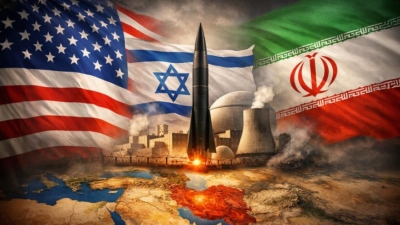
The fragile geopolitical region of the Middle East is threatened with massive escalation, as the war in Iran enters its seventh day and the deadlock for the attackers becomes increasingly visible.
Within this context the United States and Israel are beginning to desperately search for an alternative solution, which apparently will include a ground invasion.
The big question is who will undertake such a risk, with the heavy losses that a ground operation will inevitably include.
While attention had mainly focused on the Kurds, a surprising player enters the equation, Azerbaijan, which reportedly has begun concentrating troops near the border with Iran.
At the same time the Ministry of Defense, the State Border Service, the Ministry of Interior and the country’s emergency services have been placed on high alert.
“Limited military operation”
To understand the situation the geopolitical context must be examined.
The so called Second War of Iran, which began by the coalition of the United States and Israel on 28 February 2026, is in full development in the Middle East.
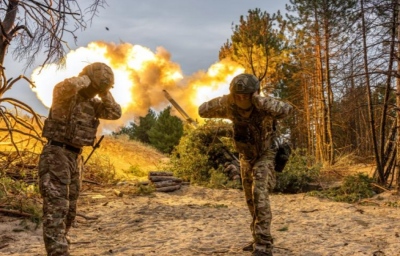
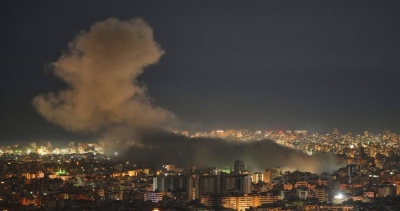
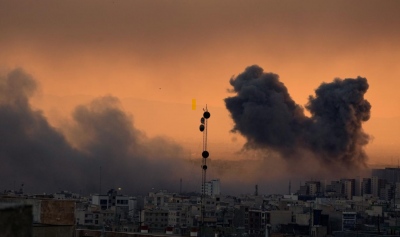
Within only one day the air force of the United States and the forces of Israel reportedly achieved full air superiority, suppressing Iranian air defenses, sinking a large part of the Iranian fleet and eliminating top members of the military and political leadership of Iran.
However the main objective of this “limited military operation” has not been achieved.
After the assassination of Ali Khamenei, his son assumed the position, while Tehran refuses to capitulate and dismantle its missile and nuclear programs.
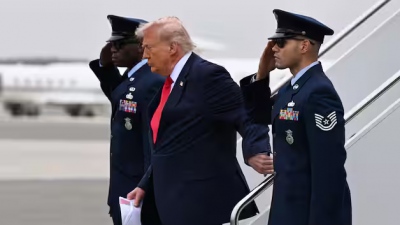
On the contrary Iranian missiles and drones are striking countries of the Middle East where American military infrastructure is located, while in the United States coffins of soldiers have already begun returning, a development expected to affect the political popularity of Donald Trump.
In order for the objectives of the operation to be achieved a ground invasion is required, however Washington did not prepare in time for such a development and today very few countries appear willing to become involved in a full scale war.
A new player in the war
Traditionally the United States attempts to use the Kurds of Iran as a regional ally.
However this time the plan appears unlikely to succeed.
Turkey, which considers a Kurdish state a threat to its territorial integrity, is expected to react strongly to any strengthening of Kurdish forces in Iraq or Iran.
Thus a new and potentially far more dangerous player has appeared.
On 5 March 2026, an alleged Iranian drone attacked the airport of Nakhchivan, an Azeri enclave bordering Turkey, while a missile reportedly headed toward Turkish territory.
After the incident Baku summoned the ambassador of Iran for explanations and began the withdrawal of diplomatic personnel from Tehran.
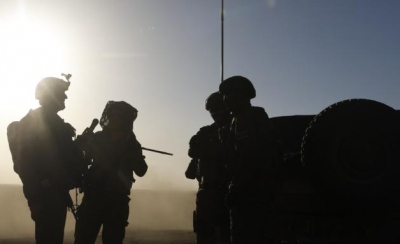
At the same time Azerbaijan placed its armed forces and intelligence services on the highest level of alert and began concentrating troops on the border with Iran.
Many analysts estimate that there may be a silent agreement between Washington, Tel Aviv, Ankara and Baku for a possible entry of Azerbaijan into the war against the Islamic Republic of Iran.
For Tehran this would represent a particularly negative development, as Azerbaijan possesses a well equipped army trained according to NATO standards which has already crushed the forces of Armenia in the war for Nagorno-Karabakh.

The “Greater Azerbaijan” plan
Unlike other leaders the president of Azerbaijan Ilham Aliyev had carefully prepared for the Second War of Nagorno-Karabakh, ultimately managing to fully capture the Armenian region of Artsakh.
Now Ilham Aliyev, as the victor of that conflict, could consider involvement in the war with Iran, pursuing multiple strategic objectives.
One of them is the union of Nakhchivan with the rest of Azerbaijan through the so called Zangezur Corridor, which passes through the region of Syunik in Armenia.
Aliyev has already warned Yerevan that the corridor will be created even with military force.
“The creation of the Zangezur Corridor fully corresponds to our national, historical and future interests. We will implement it whether Armenia wants it or not. If it wants it, it will be solved easily. If not, it will be solved by force,” he had declared.
Tehran had opposed this plan, as it considers that it would strengthen a broader geopolitical bloc of the so called Greater Turan, which would extend from the South Caucasus to Central Asia.

The Zangezur Corridor
A historical window of opportunity
With the United States and Israel severely striking Iran, Azerbaijan could consider that a unique historical window is opening for expanding its influence in the Middle East.
In the northwestern provinces of Iran, bordering Armenia, between 15 and 30 million Azeris live, meaning more than those who live in Azerbaijan itself.
This could constitute a political and strategic argument for a possible intervention by Baku on the side of Washington and Tel Aviv.
In such a scenario Azerbaijan could present its intervention not as an aggressive act but as a “humanitarian intervention” to protect the Azeris of Iran and create a security zone.
Such a development could even mark the beginning of the end for the current state of Iran.
However it could equally create serious risks for Azerbaijan itself, as many Azeris of Iran do not view positively the close relations of Baku with Turkey and particularly with Israel.
At the same time Iran still possesses military and geopolitical options to confront a possible invasion, at least for the time being.
www.bankingnews.gr



Σχόλια αναγνωστών